
Certain processes in the food, beverage, pharmaceutical, and personal care industries require equipment that protects product integrity while meeting strict cleanliness standards. At Pye-Barker Engineered Solutions, we help you identify the right hygienic pumps for your specific industry and application. Our team also supports equipment repairs, ongoing service, and system optimization, so your operations stay efficient and compliant.
Businesses that have long relied on Wright Flow equipment will appreciate the seamless transition to the Viking Pump Hygienic lineup. This collection represents the direct evolution of those trusted designs, updated with modern performance and cleanability enhancements while preserving the core reliability you already know.
If your current setup involves viscous fluids, shear-sensitive ingredients, or strict sanitary requirements, reach out to our team at (404) 363-6000 for a consultation. We can evaluate your process and recommend solutions tailored to your goals.
Hygienic and sanitary pumps are engineered to minimize contamination risks, support clean-in-place or sterilize-in-place protocols, and handle sensitive or regulated products without compromising quality. These pumps appear most often in environments where even minor residue or bacterial growth can create serious issues, such as dairy processing, nutraceutical production, or pharmaceutical manufacturing.
The design priorities typically include smooth internal surfaces, minimal dead legs, easy drainage, and materials that resist corrosion while standing up to rigorous cleaning cycles. When these elements work together, facilities can maintain product safety, reduce downtime between batches, and meet the expectations of regulatory bodies and customers alike.
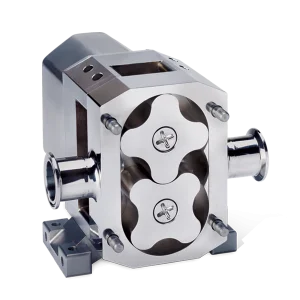
Rotary lobe pumps move fluid by trapping a fixed volume between rotating lobes and the pump casing. The lobes turn in opposite directions without touching each other, synchronized by external timing gears. This non-contacting action creates gentle handling, low shear, and minimal pulsation - qualities that matter when product integrity is non-negotiable.
Because the pumping elements stay out of the fluid path in many configurations, these pumps manage a wide range of viscosities and can pass soft solids without damaging either the pump or the product. Many models also support full clean-in-place and sterilize-in-place cycles, which reduces the need for complete disassembly during sanitation.
For processes that involve delicate emulsions, chunky mixtures, or ingredients that degrade under high shear, rotary lobe technology often provides the balance of efficiency and product protection that other positive displacement designs struggle to match. If your application requires both hygienic performance and gentle transfer, this category deserves close consideration.
For a deeper side-by-side look at rotary lobe pumps versus gear pumps in hygienic and viscous service, explore our detailed selection guide.
Viking Pump’s hygienic offerings continue the legacy of Wright Flow Technologies with refined engineering focused on cleanability, durability, and application flexibility. The Sterilobe series stands out as a rotary lobe solution designed specifically for pharmaceutical, food, beverage, and other sensitive processes.
Key features of the Sterilobe series include a cover joint profile that improves self-draining capabilities, front-loading seals that can be changed in-line without major disassembly, and a corrosion-resistant stainless gear cover paired with a powder-coated bearing housing. Optimal lubrication and thoughtful gearbox design contribute to maximum seal life and hassle-free maintenance.
Rotor options add further versatility. Bi-wing rotors provide application flexibility and excellent solids-handling capabilities, while multi-lobe rotors help reduce shear and pulsation for sensitive media. Cusps with reliefs make cleaning easier and more effective. These details work together to support consistent performance and easier validation in regulated environments.
The Sterilobe series can handle flows up to 753 gallons per minute in appropriate configurations, giving facilities room to scale without sacrificing the hygienic characteristics that matter most.
If you are transitioning from older Wright Flow equipment or evaluating the current Viking Pump Hygienic family for the first time, our team can walk you through model differences, porting options, and sealing choices that align with your process requirements. Call now at (404) 363-6000 or request a pump quote to discuss your specific needs.
Different sectors place unique demands on pumping equipment. The right hygienic solution depends on viscosity range, shear sensitivity, solids content, cleaning protocols, and regulatory expectations.
Dairy and viscous food processing often benefit from rotary lobe pumps because they handle thick products like creams, sauces, and purees while maintaining texture and minimizing product damage. Low-shear operation helps preserve quality in items that would otherwise separate or degrade under more aggressive pumping methods.
Plant-based proteins, nutraceuticals, and personal care formulations frequently involve shear-sensitive or high-value ingredients. Gentle handling reduces waste and protects the functional properties that customers expect. Easy cleanability also supports frequent product changeovers common in these categories.
Brewing, distilling, and fermentation processes require pumps that move wort, yeast slurries, or finished beverages without introducing oxygen or damaging delicate components. Self-draining designs and CIP compatibility help maintain sanitation between batches.
Meat, poultry, and prepared food lines often need reliable solids handling alongside hygienic performance. Rotary lobe pumps with appropriate rotor profiles can move mixtures containing particulates while supporting the strict cleaning regimens these environments demand.
Across these applications, the combination of gentle product transfer, cleanability, and robust construction helps facilities maintain both quality and uptime. If your process falls into one of these categories - or blends elements from several - our specialists can help narrow the options quickly. Call (404) 363-6000 for personalized assistance.
Choosing equipment involves more than matching flow rate and pressure. Start by documenting the fluid properties: viscosity at operating temperature, presence of solids or fibers, shear sensitivity, and any temperature or pressure extremes. Next, consider cleaning requirements - does the system need full CIP or SIP capability, and how frequently will sanitation occur?
Port size, seal type, and material compatibility also influence both performance and maintenance intervals. Front-loading or easy-access seal designs, for example, can significantly reduce downtime during routine service. Finally, evaluate the supplier’s ability to provide local support, spare parts, and application expertise when questions arise.
At Pye-Barker, we combine decades of hands-on experience with access to leading manufacturers, so you receive recommendations grounded in real-world results rather than generic specifications. If you are unsure where to begin, schedule a conversation with our team. We can review your process parameters and help identify the most practical path forward.
Since 1936, Pye-Barker has tested equipment and manufacturers to determine which products deliver the best combination of durability, efficiency, and value across a wide range of operating conditions. We only recommend solutions we trust for long-term performance.
As an authorized distributor for Viking Pump Hygienic equipment in Georgia, we offer local inventory knowledge, application engineering support, and responsive service for both new installations and existing systems. Our capabilities extend beyond pumps to include gear pumps, vane pumps, reciprocating pumps, compressors, blowers, vacuums, and a full range of related industrial equipment and parts.
Whether you need help specifying a new hygienic pump system, troubleshooting an existing installation, or arranging repairs and maintenance, our team is ready to assist. Reach out today at (404) 363-6000 to speak with someone who understands both the technical requirements and the practical realities of keeping production running smoothly.
What Makes Rotary Lobe Pumps Suitable for Hygienic Applications? Rotary lobe pumps use non-contacting lobes and external timing gears, which reduces shear and allows for effective clean-in-place or sterilize-in-place cycles. Smooth internal geometries and self-draining designs further support sanitation and product integrity in regulated environments.
How Do Rotary Lobe Pumps Handle Viscous and Shear-Sensitive Fluids? The trapped-volume action moves thick or delicate products gently between the lobes and casing. This approach minimizes degradation while still delivering consistent flow, making these pumps a practical choice for emulsions, suspensions, and high-viscosity formulations.
When Should You Consider Viking Pump Hygienic Equipment for Your Process? Facilities that value proven cleanability, solids-handling capability, and straightforward maintenance often find the Sterilobe series and related Viking Pump Hygienic models well suited. The lineup builds on decades of field experience and continues to evolve with modern hygienic requirements.
What Role Do Standards Like 3-A and EHEDG Play in Hygienic Pump Selection? These established guidelines help define design and cleanability expectations for equipment used in food, beverage, and pharmaceutical settings. Pumps engineered to align with such standards give processors greater confidence during validation and routine operation. Learn more from the 3-A Sanitary Standards organization and EHEDG.
How Often Do Hygienic Pumps Require Maintenance or Seal Changes? Maintenance intervals depend on the specific fluid, operating conditions, and cleaning frequency. Designs with front-loading seals and accessible gearboxes, such as those in the Sterilobe series, are intended to simplify routine service and reduce overall downtime.
Can Rotary Lobe Pumps Manage Both Low-Viscosity and High-Viscosity Products Effectively? Many rotary lobe models perform across a broad viscosity spectrum, though very thin fluids may require careful sizing to maintain efficiency. Our team can review your exact parameters and recommend the appropriate configuration or alternative technology when needed.
What Support Does Pye-Barker Provide After the Sale? We assist with installation guidance, spare parts, repairs, and ongoing optimization. Local knowledge combined with manufacturer backing means faster responses when questions or issues arise.
Selecting the right hygienic pumps or upgrading to Viking Pump Hygienic rotary lobe solutions can protect product quality, simplify sanitation, and support more consistent operations across food, pharmaceutical, nutraceutical, and personal care applications. At Pye-Barker Engineered Solutions, we bring nearly ninety years of experience, authorized distributor access, and practical local support to every project. Whether you need help evaluating options, specifying equipment, or maintaining an existing system, our team is prepared to assist. Call (404) 363-6000 now or contact us on our pump quote form today to discuss your process and discover how the right hygienic pump solution can make a measurable difference.